


It is natural to judge the health of a plant using the part of the plant we can easily see: the foliage above the soil level.
But did you know this is only the tip of the iceberg regarding how healthy and established the plant truly is?
If you’ve ever purchased a good-looking plant and then watched it quickly collapse after bringing it home, there’s a good chance that the issue was root health. This post will help you to learn how to avoid having this experience happen to you again.
Today we will discuss why root health is so important, how to know whether roots are healthy, and why knowing this will dramatically change your success as a plant grower.
I would argue that this topic is possibly one of the most important topics I have ever discussed!
Disclaimer: When you buy through links on my site, I may earn an affiliate commission at no cost to you. I only recommend products I use and love. All proceeds go back to supporting this blog. Thanks for your support!
Why is root health so important to your houseplant’s overall health?
The roots of a plant allow the plant to uptake water and nutrients – so if the roots are not working properly, the plant’s ability to drink water and maintain a nutrient balance for optimal health is compromised.
If the plant struggles to hydrate itself and absorb the nutrients it needs, the health of its stems and foliage also begin to weaken.
Plants in a weakened state are very desirable to pests, who know that these plants have fewer defenses to fight them off.
Simultaneously, roots in poor health begin to die off.
Dead roots are particularly problematic when water is introduced. In other words, when you water your houseplant and it has dead or dying roots due to poor health, that creates rotting or decaying matter.
And that rotting or decaying matter invites bacteria that feed on rot to move in to break that matter down.
Dead stuff (roots) + Water = Rotting stuff where bacteria come to help break that rotting stuff down
You can see how we’ve now got a horrible situation on our hands:
- The plant struggles to absorb water because its roots are in poor health.
- The foliage and stems start to weaken from lack of water and nutrients
- The overall weakening of the plant invites pests to move in
- The dead and dying roots invite bacteria to begin feeding and breaking down the roots, causing root rot
And the worst part about all of this…. is that you could have purchased a plant that looked fine in terms of its foliage, but its roots were not healthy. And you didn’t see the effects of its poor root health until you had the plant home for a week or two.
There are times when plants can be saved in these scenarios, but it takes a lot of patience and time. And often the plants never look the same as they did.
It is much, much easier to start with a plant that has a healthy, robust root system and then work to keep that plant’s healthy, robust root system going.

Here’s a non-plant analogy
I’ve been trying to come up with an analogy to help people understand what is happening with their plants and here’s the best one I’ve thought of so far:
If you stop working out and start eating less nutritious food, the muscles you previously worked hard to build start to slowly break down while the fat content in your body begins to increase.
After some time, you have less muscle and more fat.
When you decide you’d like to gain back muscle and lose fat, it takes a lot more work to get back into shape than it did to stay in shape. Because when your body is in shape, it is much easier to keep doing the things you are doing. It is much more difficult to start doing those things and get back to the level of fitness you were once in.
I know this personally. I’m still not back to where I was, strength-wise. But I hope to be someday. 🙂
Here’s a plant example
I’ve had multiple plants look terrible, aesthetically, due to neglect.
I was ready and willing to get rid of them because I knew I was neglecting them for two reasons: I had too many plants and I wasn’t enjoying caring for the plant anymore.
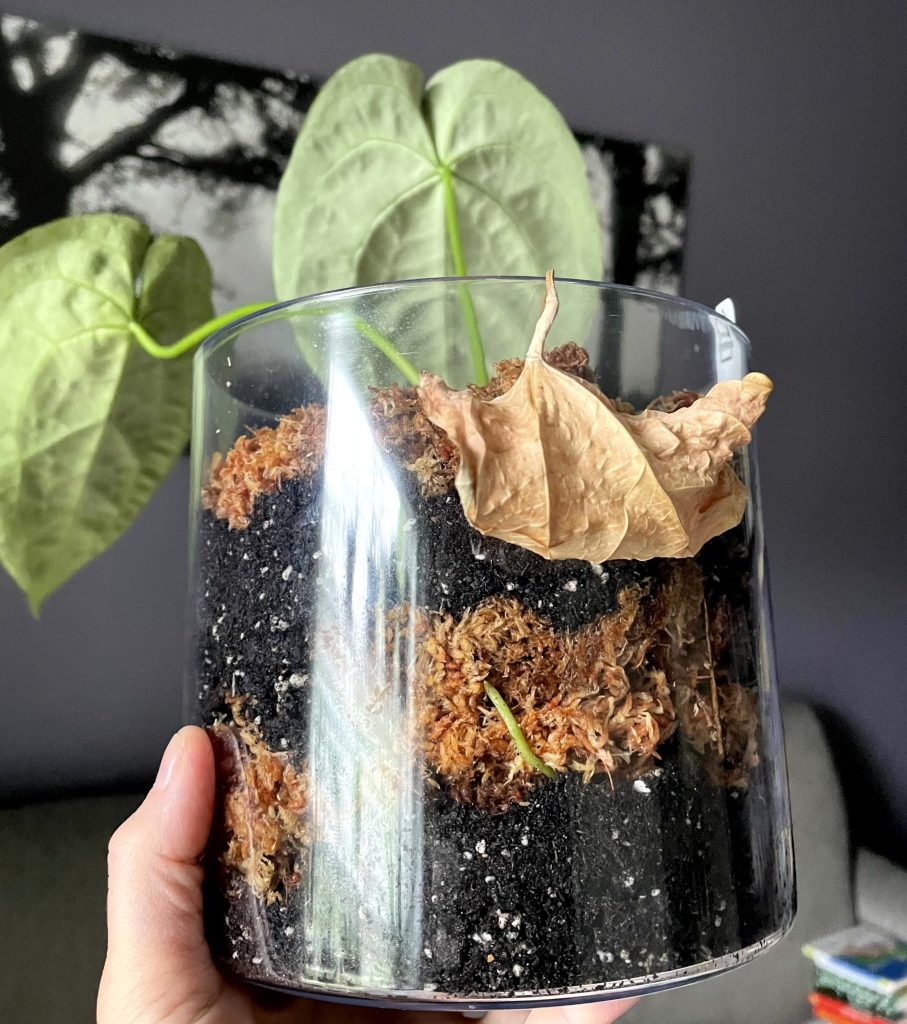
Then I removed the neglected plant from its pot and hiding inside the pot was a gorgeous, full root system.
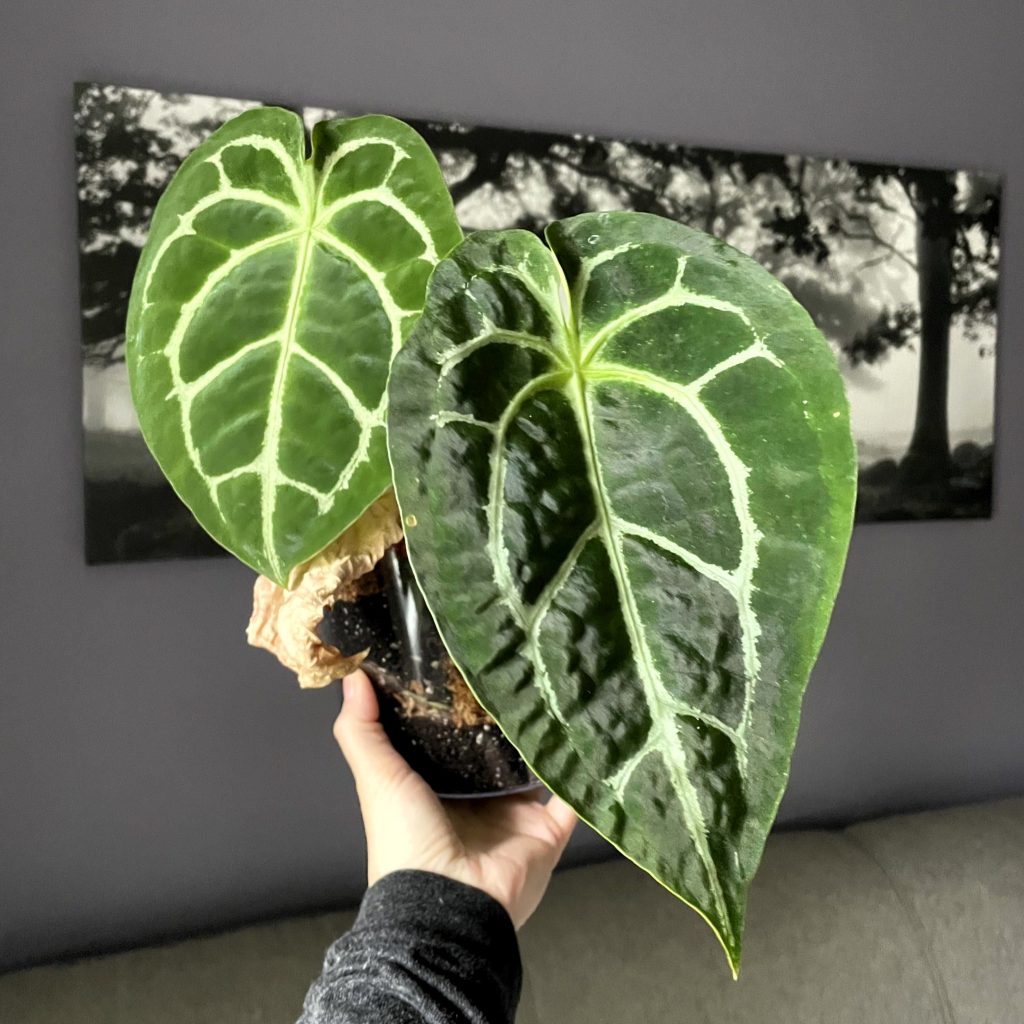
One example of this is this little Anthurium hybrid I will include a picture of below.
It was in a tiny 3-inch pot, shoved on a shelf in my bedroom, with my other velvet leaf anthuriums.
I just wasn’t watering it as much as I should and the plant looked awful. The leaves were ugly and there was only one or two left, hanging on for dear life.
I assumed the root system would look a lot like the leaves did due to neglect.
But when I removed it from its pot… the roots were absolutely beautiful and so well-established in the pot. I was shocked to see so many plump white roots.
I changed my plan right then. This plant was far from unhealthy. The top, foliage portion looked sad. But the roots were doing just fine. It would need time and patience, but I had no doubt that it would pay off.
That was a few months ago and here are the adorable little leaves I’ve gotten since. The older leaves are still attached and completely dried up. Fine with me.
It will still be more time before I have a true showstopper of a plant, but gardening is a quick game anyway. I’ve got plenty of time.
How do you know if a plant has healthy roots?
Healthy roots look a lot like undercooked spaghetti. They are firm, relatively consistent in color, and appear hydrated (not deflated, or mushy, or falling apart.
While many plants do have white-ish roots, it is a myth that roots should be white. Many, many plants have roots in other colors (pink, orange, black, tan, yellow, green, and even black). So looking for the roots to be white is not a good way to determine health.
What is helpful, however, is to look for a fairly consistent color without mushy, stringy, deflated roots.
If you see drastically darker roots than the rest, that is a potential sign of trouble. Dark root tips or segments, especially paired with mushiness, are often signs of root rot.
If you see roots that look like they’ve collapsed in on themselves like a flattened straw, that is also a sign of trouble. Root collapse is often a sign of dry root.
The term “root rot” is usually applied when a plant has been exposed to too much moisture for too long, which has caused the roots to begin to rot.
The term “dry rot” is typically applied when a plant has suffered from too little water, which has caused the roots to die back. Then, when those dead roots are exposed to water, the dried-out roots begin to rot.
The result of root rot and dry rot is the same (rotting roots), but the cause is not.
To summarize, you want to look for:
- Roots that are mostly consistent in color and feel pretty firm.
- Roots that do not break apart easily, do not feel mushy, are not super dried out and collapsed in on themselves
- If you tug at the roots, they do not come apart in your hands and do not lose the outer when pulled.
- If you smell the roots or the pot, it might smell like dirt or like a humid forest, but shouldn’t have a strong foul odor. If the pot smells swampy, that’s a bad sign.

What is a well-established plant root system?
A well-established root system is not the same as a healthy root system. Let’s talk about what the difference is and why it matters.
A Healthy Root System
- A root system of any size (whether the roots are a half an inch long or miles long)
- Appears robust and turgid (not flat or deflated)
- When gently pulled, it doesn’t fall apart or remove any layers
- Ideally, if the roots are thick enough, you will also see new roots growing as well (less likely to be true of smaller, newer root systems)
A Well-Established Root System
Just because a plant’s roots are healthy, does not mean they are well-established.
Well-established roots give the plant its best chance at growing and adapting to your environment. It is a sign that the plant is somewhat mature, in that the plant has a good root system to support its growth and adaptation.
Not only do established root systems securely support the plant (literally keep the plant in place and upright), but they also allow the plant to adequately uptake water and nutrients.
The bigger the root system is in relation to its pot size (within reason), the more likely the plant can:
- withstand a period of drought or a period of too much water
- bounce back from diseases and pests
- grow back from a large pruning
- grow more quickly
- grow more healthy, mature foliage and stems
- more likely flower
There are many advantages to having a more established root system. These are just a few.
My best analogy here is how education can help people in life:
You are going to start a new job. You have a robust education that has given you a lot of knowledge about how to do this job.
That education will help you to feel a lot more confident stepping into this new job than someone else who has only watched a few YouTube videos about how to do the job.
That education will also give you the ability to navigate different circumstances and obstacles more successfully (most likely) than someone without the same education because they do not have the same educational experiences to know what to do in those scenarios.
Education can be in many forms. It can be institutional (like public schooling, colleges, etc), but it can also be on-the-job training, personal experience, mentorship, or, in this case, personal growth through growing and maintaining healthy roots over time.
That is the difference between a well-established root system and a healthy, but much smaller root system. One is just more equipped to weather change and obstacles.
What does a well-established root system look like?
Well-established root systems:
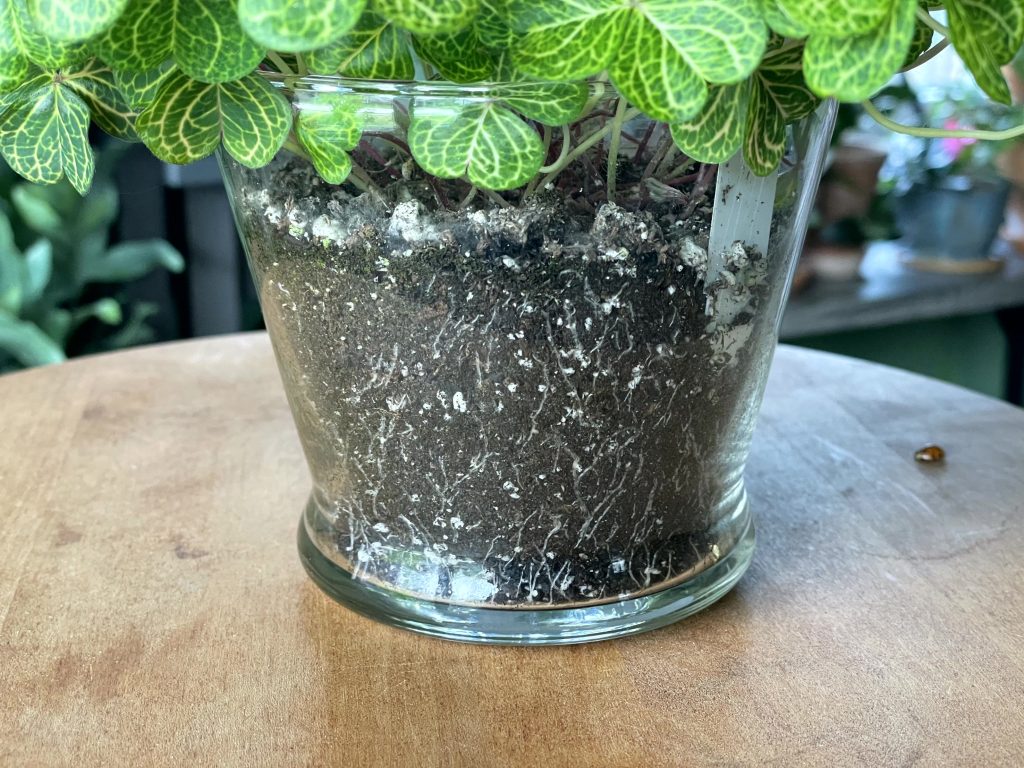
- have grown to spread throughout about two-thirds of the plant’s pot or more.
- If the plant is in a plastic pot, you can test this by removing it from its pot (by turning it over and squeezing gently) and seeing whether the root ball stays together with the potting mix.
- The roots may hold the shape of the pot but are not so overgrown that you can hardly see any potting mix left.
- When you can see almost no potting mix, this is a severely root-bound plant. If the roots look healthy, that is okay for the most part. But sometimes, when severely rootbound, the plant can suffer from underwatering and be susceptible to dry rot.
- are made up of healthy roots (meeting the list of characteristics previously described)
- and does not necessarily require the foliage of the plant to be pretty.
Conclusion
While all of the parts of a plant are important and certainly matter to its health and your happiness with growing that plant, the roots play a major role in the health of a plant.
Knowing whether a plant’s roots are healthy (and having the ability to assess root health) can provide you with the information needed to maximize successful experiences with houseplants.
Ideally, you want to find a plant that has a healthy, well-established root system. Doing so can dramatically increase your chances of growing the plant successfully.
Disclaimer
This advice may not work for every houseplant grower, but it works for me and my plants!
If you do something different that works better for you, share it in the comments below! That’s how we learn and grow as a community.
Related Posts
How Your Plant is Telling You It’s Time to Repot (with Pictures!)
A Simple Guide to Root Rot: How to Identify, Control, and Prevent It.
0 Comments