


I have tried SO MANY pest management routines, including tons of different products, beneficial insects, quarantine bags and boxes, etc.
It becomes very cumbersome and expensive to do many of these routines when you have such an extensive collection.
I’ve finally found a solution that is easy, cheap, and effective for me, and I’m sharing it with you today!
My Favorite Tip & Tool: Rubbing Alcohol
I use rubbing alcohol by itself in a spray bottle to manage most pests. Basically, everything except for fungus gnats and scale.
Rubbing alcohol has been a very effective pest treatment for me. I do NOT dilute it.
I fill the little glass spray bottles pictured below with 70% isopropyl alcohol.
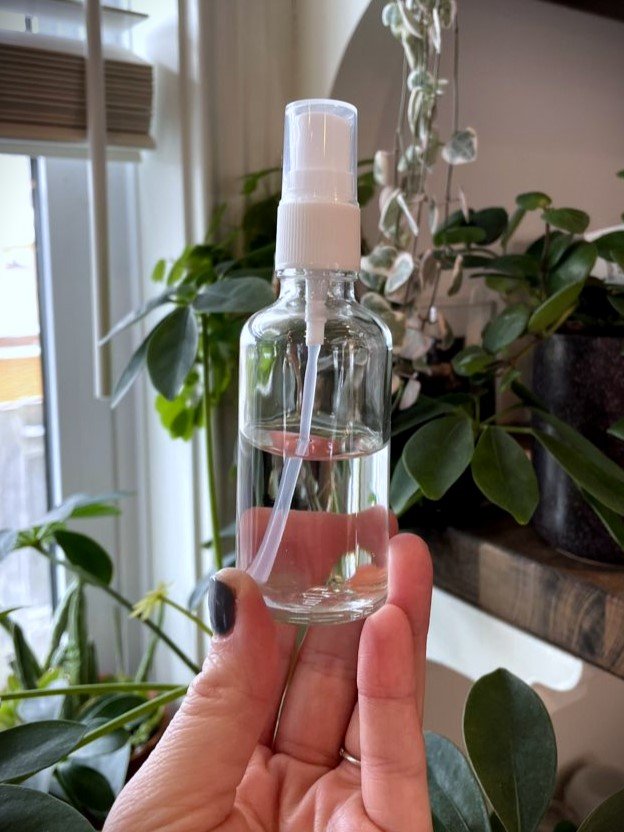
I like these bottles because they are easy to carry around for spot-treating plants as I stumble on issues, and they have a spray that isn’t too narrow or too wide.
Does it damage the leaves of my plants? No, it doesn’t, but I avoid spraying leaves that I consider particularly sensitive.
What plants do I consider particularly sensitive? Ferns, African violets, gesneriads, and oxalis.
Some examples of plants I’ve sprayed successfully are Anthurium, Philodendron, Alocasia, Hoya, Scindapsus, Peperomia, Epipremnum/pothos, Ficus (like the Fiddle-Leaf Fig, Rubber Trees, and others), jungle cacti (like Rhipsalis, Epiphyllum, etc), Schefflera, Pachira aquatica, Cacti, Euphorbia, and more.
Here’s how I use the rubbing alcohol spray:
When I find a pest, I spray the leaf/stems or wherever I see the pests with rubbing alcohol.
I observe the pests closely to ensure I sprayed them thoroughly.
Sometimes, it takes a few sprays to thoroughly saturate a mealybug nest or ensure I coated a high-traffic pest area.
For mealybugs, it can be helpful to use something to pick apart the nest because they tend to pile on top of one another. I will use my fingers in easy-access areas, but tiny nooks and crannies are more suited for toothpicks or chopsticks.
I don’t wipe off the rubbing alcohol or do anything fancy.
Keep the plant out of direct light after spraying it to prevent leaf burn.
I keep the spray bottles super accessible because I use them for spot treatment and pull them out often.
So whenever I see a pest, I grab the bottle and spray it.
If I know a plant has pests, I will check every couple of days to see if there are more bugs and spray them again.
It takes a little time and patience, but they go away with this incredibly simple and stress-free method.
By using this method, I’ve controlled all kinds of pests. Most notably, thrips!
Scale is the one pest that is a little trickier because of the hard shell. The spraying can help, but manual intervention is required.
What if the plant is badly infested?
If pests are sneaky and get the opportunity to badly infest a plant, I ask myself how much I really like the plant?
If I can live without that exact plant, it gets composted because the infestation isn’t worth it.
Why isn’t the infestation worth it? Because large infestations are difficult to control and are highly likely to spread to other plants in the home. I don’t want an even bigger problem!
If I really love that exact plant, I will often move the plant as far away from others as I can, which is to the detriment of the infested plant because it will be getting less light or less ideal conditions in this remote spot.
I will shower off the plant in its entirety with water and spray the entire plant with some kind of pest control like Captain Jack’s Dead Bug Brew. Then, I will use a soil drench.
A soil drench is a type of pest treatment that is watered into the soil and taken up by the plant’s roots the same way water would.
This gives the plant the opportunity to have pest prevention on the inside, so when the bugs bite it, the bugs get sick and can’t continue to live.
What do I use for a soil drench? I buy pre-mixed neem oil spray and water the plant with it as if it were a normal watering can (with the top off). I’ve also used Bonide Systemic, but because of how toxic it is, I limit its usage.
Sometimes, I have to repeat a neem application, but after a couple of drenches, the plant is often doing better.
Summary
Tip #1: I’ve found that rubbing alcohol spray is an easy and effective way to manage pests
Tip #2: I usually compost badly infested plants
Tip #3: I use soil drenches for more significant infestations
Tip #4: I use water to clean off a plant. It’s an excellent, nontoxic, inexpensive tool as well.
Tip #5: I don’t stress. Pests are part of nature. They are annoying but expected.
Disclaimer
This advice may not work for every houseplant grower, but it works for me and my plants!
If you do something different that works better for you, share it in the comments below!
That’s how we learn and grow as a community.
Related Posts
Get Rid of Fungus Gnats Quickly Without Getting Rid Your Houseplants!
Are the Chemicals We Use to Control Houseplant Pests Safe for People and Pets?
0 Comments