

If you are wondering whether it is time to repot your houseplant, this article will give you 5 easy ways to answer that question.
#1 If you’ve had the plant for more than 2 years and you haven’t repotted it yet, it’s time.
While there are always exceptions to the rule, most houseplants benefit from new soil every two years.
Why? This allows old, compacted soil to be removed and replaced with nutrient-rich, well-aerated soil.
You can also see the root system and decide whether the plant needs a larger pot. More on how to know whether the roots need a larger pot below.
#2 If the soil is hard and you can tap your finger on it without it moving, it’s time for a repot.
Some of the soil mixes that big growers use become very compacted over time and as they dry out.
This transforms the soil from a soft, fluffy place to live to a hydrophobic brick, meaning that the hard soil repels water or doesn’t allow water to run through it anymore.
You may think you are watering your plant, but there is a chance the water no longer penetrates the soil once it’s reached this hardened state.
To free the plant from the compacted soil, let the whole pot of soil soak in a bowl of water until it’s super heavy. That’s how you’ll finally know you’ve saturated the soil.
It may take some time, depending on how dried out and hydrophobic (water repellant) the soil has become.
Once the soil has been saturated, you can remove some of the old soil mix to prepare it for repotting.
#3 If your plant is drying out much faster than it used to, it’s time to repot.
If you feel like each time you check on your plant, it is bone dry, that might just be a sign it has outgrown its pot.
Once the roots have consumed the majority of the pot, there isn’t a lot of room for moisture to linger, and the water you provide gets used up rapidly.
That means you are much more likely to find a very dry plant, see it wilting, and wonder why you just watered it, only for it to be dry again
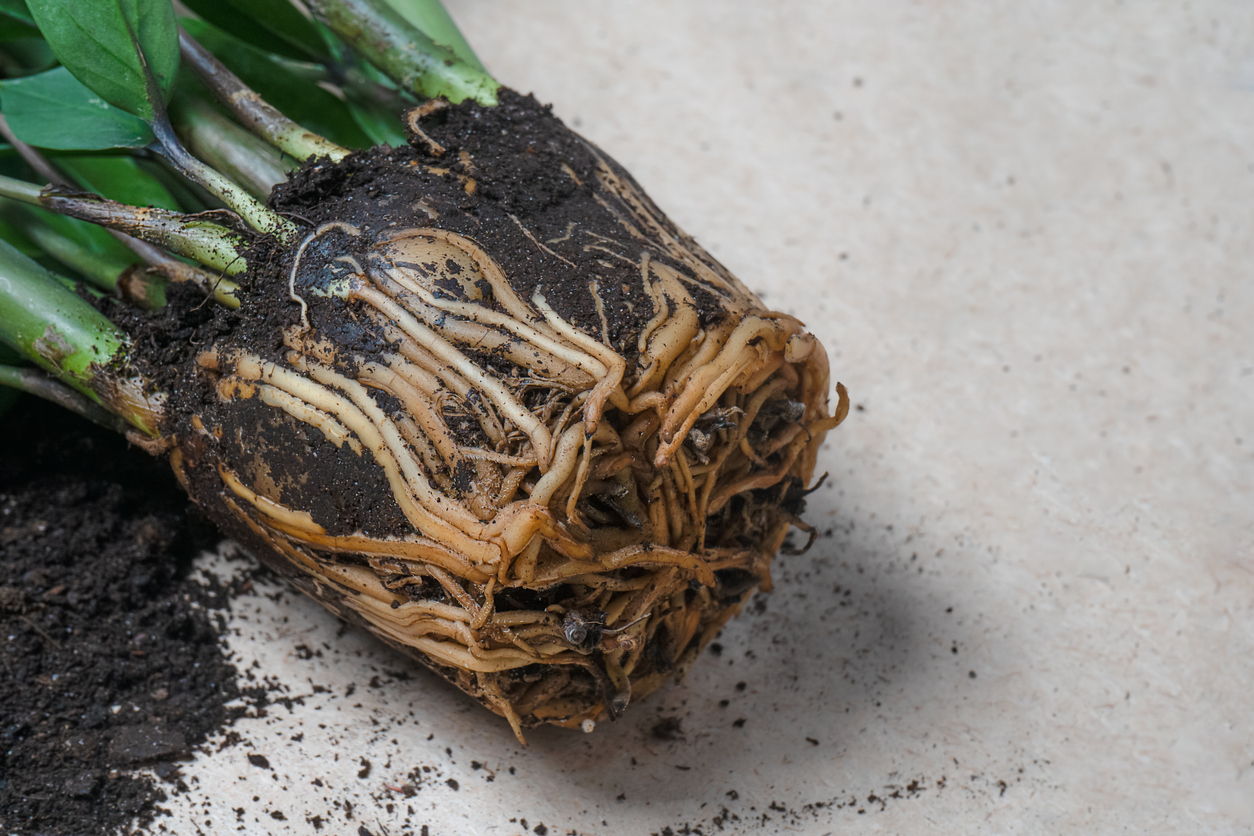
#4 If you peek at the roots and they have consumed most of the space, it’s time to repot
When you remove a plant from its pot, you can see how much the roots have grown.
If the roots are taking up more than half the pot, it is time to move up to the next size.
The photo believe shows Anthurium roots that were way past time to repot. The roots have consumed 80 to 90% of the soil.
It would have been better if I had repotted sooner, closer to the 50% mark since Anthuriums really do not like to dry out so much. Thankfully, it tolerated my neglect well.

#5 If your plant has stopped growing or its growth is stunted, it might be time to repot
Some plants will stop growing when they no longer have enough space inside the pot. Alternatively, the plants may still grow, but the growth might be smaller and less robust. Both of these can be signs that the plant has outgrown its pot.
This can happen for a number of reasons:
- The roots are super rootbound and have no space to expand any further to support foliage growth
- There is so little space for soil that the plant cannot retain moisture for long enough to support growth
- There aren’t enough nutrients to support growth
- Some plants, like aroids, need enough space around their roots to support stem and leaf growth
However, it is important to note that plants can stop growing for other reasons as well. Please check out the blog post linked here for other unrelated reasons to help you troubleshoot if you aren’t sure.
Happy growing!
Want more in the Start Here Series? Check these out:
- You Can Learn How to Grow Houseplants. Start Here, #1
- How to easily ensure your houseplant will get enough sunlight. Start Here, #2
- How to water your new plant (and feel good about it). Start Here, #3
- Fertilizing a houseplant seems complicated, but it’s not. I’ll prove it. Start Here, #4
- 5 Easy Ways to Know if Your Houseplant Needs to be Repotted. Start Here, #5 (You are here)
- A Fast, Easy Guide to Help You Repot Your Houseplant. Start Here, #6
- What about pests? What does a beginner need to know? Start Here, #7 (Coming Soon)
0 Comments